A Missing Piece in U.S. Dyscalculia Research

Recently a school administrator asked who my favorite U.S. dyscalculia researchers were. It was an awkward pause before I told them I had not yet found a university professor in our country who really understood dyscalculia, and whose work adequately recognized what it means to be a dyscalculic individual.
In the U.S. there is still much debate around dyscalculia, whether it describes a particular condition, or whether it includes all students with math comprehension challenges. There is little consensus on how to define dyscalculia, how to diagnose it, or how to separate it from other reasons a student may struggle in math.
I’ve heard it said that the research and supports for dyscalculia are 30 years behind that of dyslexia, and this delay is evident to the parents, educators, and adults I work with.
Because of this, I’ve turned to information and research from the UK. They seem to have a better grasp of dyscalculia and its impact. Brian Butterworth is professor emeritus at the University College London and author of several books including Dyscalculia Guidance and Dyscalculia – From Science to Education. I’ve been most influenced by his work and his compilation of global dyscalculia research. I’ve also connected with several UK educators and authors working in this specialized field of dyscalculia. Scotland’s education department has a complete website with a working definition of dyscalculia along with resources, checklists, and information. The Dyscalculia Network offers trainings and supports for dyscalculic individuals of all ages.
I often feel impatient with the lack of U.S. awareness and research in this critical area. It’s as if I’m watching a game of “Hide and Seek” where the seeker is guided by hints of, “You are getting warmer (closer to the target)!” or “You are getting cooler (further away).” I want to shout to U.S. researchers, “You are lukewarm. Go in this direction!”
What is holding U.S. research back?
Most dyscalculia research in the U.S. is focused on math performance in the classroom and establishing research-based math instruction guidelines. The term “dyscalculia” is rarely used, instead the terms “math learning disability” or a “specific learning disability with an impairment in math” or even “math disorder” are used by psychologists and researchers.
I’m not complaining about this math-instruction focused research; I think it is tremendously helpful for struggling students. But it is not enough.
This approach doesn’t address the unique experience of being dyscalculic and it lumps all math struggles together. This limited scope of study means that our work developing meaningful education and workplace supports for dyscalculia remains stunted.
I don’t know about you, but I want more than better math class instruction for the 17+ million dyscalculic Americans who are struggling. As a parent of a dyscalculic, I want to advocate for and empower these individuals to confidently navigate our education and societal systems, even with a unique and challenging disability.
Getting “Warmer.” How do we head in a better direction?
I have three suggestions for how to broaden our research scope and better explore dyscalculia:
Expand the research beyond the confines of the math classroom, and study how students process and understand information and tasks related to number and quantity. Most parents and teachers have no idea of dyscalculia’s far-reaching impact. And neither do our researchers.
This means we don’t just evaluate students on their math calculation abilities. We need to learn from our students about their overall experience with numbers and comprehension of quantitative information in school and in everyday life.
Interview parents who are living with dyscalculic children and ask about their observations of their child’s struggle with numbers, quantity, amounts, and calculations. As a mother of a dyscalculic individual, I can talk with you about the many daily challenges my daughter faces with information and tasks involving numbers and quantity, unrelated to math class. I have keenly observed her with a growing understanding of dyscalculia for the past 10 years, so it is easier for me to describe the impact now more than I could in the beginning.
In the early days, there were many things I didn’t realize my daughter experienced differently than the rest of our family. I slowly became aware of the impact of dyscalculia on playing games, recognizing amounts, low scores in history class due to numerical data, inability to read music, and her defense-mechanism of blocking out even seeing the numbers around her.
(In my book, I wrote about many of the impacts of dyscalculia on daily life. Read the first chapter on signs and symptoms for free at: discoveringdyscalculia.com/book)
This week while I watched the exciting mid-term elections, I noted once again how confusing and inaccessible all the numerical information would likely be for dyscalculic individuals. It’s parental observations like this that can help broaden and expand our perspective on dyscalculia.
Interview more adults who are dyscalculic about their lifelong experience with numbers and quantity. Contrary to how we speak about learning disabilities in our culture, one does not grow out of dyscalculia in adulthood. When my daughter went to college she was asked for documentation proving she was still dyscalculic. This is evidence of the common and frustratingly misconception in our culture that learning disabilities only impact school or learning.
While it can be difficult to find adults with an official dyscalculia diagnosis, you can start with individuals who have struggled with math and numbers their whole lives. Or reach out to me for ideas. I know many of these individuals.
Sasu Laukkanen, a Finnish writer and author of the Substack On Dyscalculia has this to say about how an adult lens of dyscalculia would give us a clearer picture of dyscalculia.
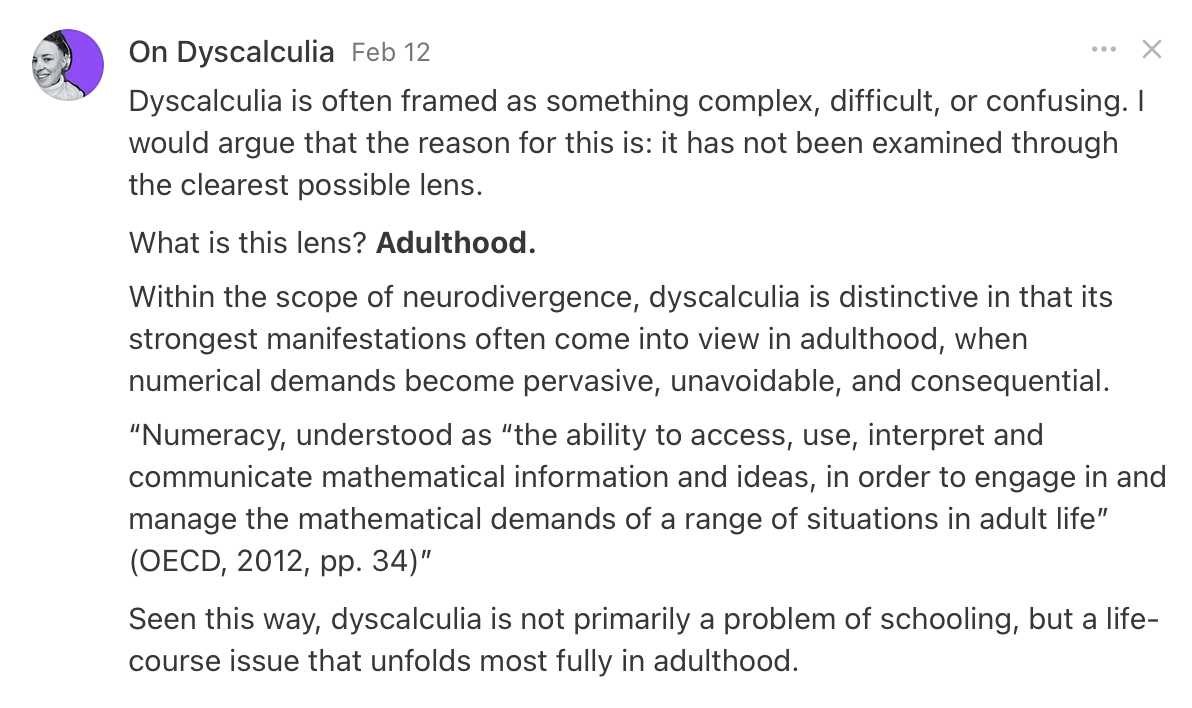
quote from Sasu Laukkanen, a Finnish writer and author of the Substack On Dyscalculia. February 12, 2026
Concluding Thoughts
If U.S. researchers would take a broader perspective of what dyscalculia is, how it impacts more than math class, and its impact on individuals across the lifespan, we would make more meaningful strides in our research.
A more accurate understanding of dyscalculia would pave the way for more effective teaching strategies, transformative developmental therapies, better school accommodations, successful daily life tools, and workplace awareness.
To get there, we need to begin with greater curiosity and empathetic listening to our students, parents, and dyscalculic adults. Together we can make a real difference in our society and educational systems for the recognition and inclusion of dyscalculic individuals.
New to Discovering Dyscalculia? I’m Laura M. Jackson, parent, author, and dyscalculia specialist supporting families, educators, and students in their journey with dyscalculia. I write, speak, and coach for dyscalculia awareness, education, and supports.