Author Chat with Tanita Davis
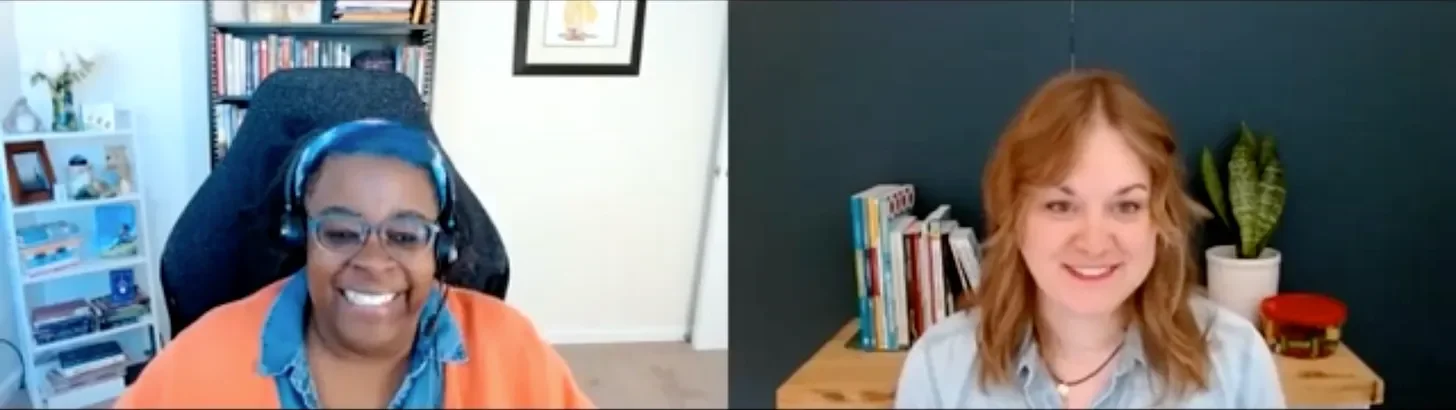
Author Tanita Davis talks about growing up with dyscalculia in the 1980’s. And a word of encouragement.
This is a transcript from a conversation I had with Tanita Davis, award winning author of numerous young adult novels. We talk about navigating childhood with an undiagnosed learning disability, how she discovered she was dyscalculic, and how this awareness has helped her as an adult.
I have slightly abbreviated this transcript, mostly cutting my questions and extra talking so you can get to the heart of our conversation (recorded in 2024).
I know you’ll love this chat as much as I did.
Laura: Today I’m excited to have an author with me today. Tanita S. Davis is the award-winning author of eight novels for middle grade and young adult readers.
One of her latest books was recommended to me by a parent, Figured it Out, Henri Weldon. The main character in the book is a seventh grader who has some very real middle school challenges and one of them is dyscalculia, so she has a math learning disability. So welcome, Tanita, thank you for coming.
There are only a few books, and maybe by “few” I mean two, that accurately talk about how being dyscalculic doesn’t just impact math class. You had so many great examples. I was reading through and I thought, this author has a deeper understanding than I’ve seen and I got to talk to her. There were things like getting lost in the halls at school, which has happened in our family, locker combinations, yes math struggles and yes the classics like multiplication, but also reading bus schedules and figuring out times and day calculations like how to be on time somewhere and figure out if you have enough time to do something.
How did you so well capture what it is like to have a math learning disability?
Tanita: Well I did a lot of the poking around on the internet, as you do. I did a lot of reading, but as you said, there’s mostly stuff about dyslexia, which is for whatever reason a much more… I don’t know it’s so interesting, because a lot of the time these things overlap and come together but somehow in our society we have decided that one of them we talk about one of them we don’t. I found some books that are for smaller children and there are a lot of things about you know using manipulatives with your kids and this and that, and how to sort of bump up a child’s understanding to get them through kindergarten in those early grades. But I couldn’t find anything either that was fiction, and I was like there has to be something! And there was not. So what I did was stick to the research side. I read a lot of educational psychology, I read a lot about neurodiverse kids. I read accounts of people who worked with those kids. There were some accounts of students online who were writing for themselves. But little by little I started to think, you know my experience is valid and I need to include myself.
It’s so weird the thing that we do, we sort of, especially because you know you don’t want to misrepresent, you don’t want to get it wrong, and so you go to the experts. But my experience is kind of expert too in as much as this is something that has been a whole thing in my life. I remember I started to think about things that were of great disappointment to me. Our classroom was set up in the fifth grade that you could have free time if you pass these timed multiplication tests. So I never, ever did. And it was so hard. Everybody else would get the popcorn party and I’d be like “Yeah, well you know.”
Laura: You were probably waiting for the time to be done. That is what it was like for my daughter, because she would just quietly looking around. She did the one times tables and then…
Tanita: Then sort of writing stuff. Drawing. Making patterns. So yeah.
Laura: So much doodling.
Tanita: A lot of doodling, yeah.
Laura: Which some schools are okay with and some, from our experience, are not okay with.
Tanita: No, yeah, that is somehow proof that you’re just not paying attention, and if you would just attend.
Laura: Yeah, absolutely. You alluded to your experiences. What was that like growing up struggling with math, and obviously no one was talking about, it how did you think about that as a kid?
Tanita: Well, there’s not too much to say. It was kind of grim. It was the 80’s.
Laura: Yes, I am a child of the 80’s as well.
Tanita: Okay so and then I’m a minority so the 80’s were not a super great time for minorities. Everybody was waiting for black kids to screw up, have a crack baby, and go to jail. It felt like our family, my parents are religiously conservative and politically conservative, and we were very much involved with our church, and I went to a parochial school. And of course we were also in a mixed community where it was predominantly people of other races. So, here we are and I think my parents really felt like there was just a spotlight on us and we felt very much compelled to do well, to be good, to not cause comment, just kind of stay under the radar sort of thing. And imagine, in that environment, in this sort of you know you’re the mom who’s carefully trying to be a part of the Parent Teacher Association, and make sure that your family’s well represented, and you’re starting to get the notes that well your daughter’s not paying attention in class, and we need you guys to come down, and we need to talk about this. It was hard.
Laura: That is grim, and with all that on top, and it wasn’t even an option to probably not try to succeed. It’s like you got to. You got to get through.
Tanita: Yeah and the disappointment wasn’t just like, “We’re disappointed,” from the teachers. It was, “We want you to be better than this.” It was not about a subject so much as it was like, “Well you need to try a little harder.” And a lot of those little talks were, “Your parents are doing their best for you and you really should be…”
Laura: Oh my gosh, it just it just makes me more than cringe.
Tanita: Yeah, it’s the implied that I wasn’t holding up my end of the bargain.
Laura: Let’s talk about who’s not holding up their end of the bargain here - schools, grown-ups.
How did you…I wanted to say how did you “figure it out?” How did you put it together and when and how old were you and what’s that kind of journey or process of realizing, I’m not just bad at math, and I don’t just need to try harder.
Tanita: It came when I was well out of school, well out of college. I think that because people, for whatever reason, I guess in part to the research back then, but people didn’t have a name for what the problem was. I attended tutoring every morning for an entire semester in college to get through one class and it was with the professor himself, so he knew that I was doing my level best, and he would, I mean the man gave his own time to me before class started for 30 minutes every single day, and I got out of that class with pride with the D. That was the lowest grade that I had in my entire college career, but I was proud of the D in a really weird way because it’s a passing grade!
Laura: And in a place where no one is acknowledging what the real issue is. So you did, you triumphed in there.
Tanita: When the professor didn’t keep saying anything along the lines of, “If you’d pay more attention…” when he just said, “No, this is where you’ve made the mistake” and backed me up and walked me through it, I realized, okay so it’s not sort of a you-should-have-gotten-this…I didn’t get that feedback from him. And I realized okay, yeah, this might be actually something, and not just in my head like there’s something wrong with me. Because part of the reason I think that so few people talk about dyscalculia or dyscalculah, which is what I ended up calling it, it’s one of those words you read and you’ve never heard…
One of the reasons I think people don’t talk about it is, this entire society has a shame response around mathematics. Somehow, I don’t know why, but reading, there’s the idea that either more people were open about their struggle with it or it’s something that not a lot of you know or everyone doesn’t find entertaining or whatever, so they’re like, well as long as you can read street signs or whatever it’s fine, you don’t have to read for fun, you don’t have to, you can sort of get through it, or whatever maybe that’s the attitude. But the attitude that math is with you and everything and that you absolutely must know and it’s a terrible terrible thing if you don’t have skill in it. I don’t know, but since there was no name for it and there was no response that I got that was shocked that I wasn’t getting it, I actually started doing some reading in my 30’s.
Now I was working at that time in education, I worked for the State of California in a group home situation. My students were truant from about fifth grade, many of them based on their parents and sort of the ramshackle way they were being raised. They had a lot of school days they missed. But then coming back we were doing a lot of remedial stuff where they are in junior high, but they’re just being introduced to fractions and all of that.
Laura: Right and it’s the first time they’ve been able to maybe even engage in this. With all the other things you can’t learn when you’re in chaos and trauma.
Tanita: Exactly and so some of them had struggles from there and so it was understanding how to teach them based on the struggles that I had. Now I do find it interesting, I don’t know if this is something that happens for a lot of people, but I find it sometimes easier to understand a thing, even temporarily, because most of my learning mathematically it comes and goes, but if I can explain a concept and we can do the problems together, it helps me to explain it to someone else. It helps it stick in my mind for a little longer. I found that I taught my students in the way that made sense to me, that some of them were able to grasp onto it, when I gave them the little hints and the ways that I did them.
And they were being tested because this is a state run home and so they’re being tested and they’re showing signs of the dyslexia and they have some at the time they were calling them “math deficits” and that sort of thing. And there still wasn’t a specific name but it was very clear. I was like, huh, I think that might be me too. It was a good time. I really enjoyed that job, simply just saying, “Okay none of us know anything today, we’re going to sit down and we’re going to learn a thing.” And it was a gift for me to be able to take the pressure off somebody else.
Laura: What difference has that made for you now as an adult to know about this neurodivergent part of yourself, and as you look back, what kind of impact has that had for you.
Tanita: It really makes a difference to the things that I look back on and felt so much failure about. My dad was a very strict disciplinarian, very much of the you’re not measuring up here, so we’re going to do something about it. And every single day in the summertime, before every meal, I had to recite my times tables. And memorizing them was the only thing that I could do. But you know it’s noise.
Laura: Yes, you’re almost memorizing the sounds.
Tanita: I did memorize the sounds. And when you skip you know because the rhythm isn’t right. So essentially it was a song and eventually I learned it. Although the eights, I don’t know what it is about eights. The eights weren’t sticking, but of course in our family it wasn’t, you don’t just do well, you do above. So we were meant to learn to 13.
Looking back as an adult now realizing that was never going to happen, it’s a relief that it wasn’t just like… I don’t know, to a certain extent I think kids almost think, “Why can’t I just do what I’m supposed to do?” It’s a weird time of life when you just really blame yourself. Just knowing that I wasn’t somehow in some back corner of my mind, just being really oppositional like, “Nope. Not going to do it.” I mean there’s a strange sense of having blamed myself for a lot of the predicaments, a lot of the trouble I got in, and knowing that it was not a choice on my part and it was a choice in how people chose to deal with it. You are able to forgive yourself for just being who you were, who you are. It actually frees you to go ahead and embrace who you are and say, “Okay knowing this, what can I do?
Because when you’re not trying to dig yourself out of a hole of who you think you are, or who you think you’re supposed to be, you are freed to be or do anything within your power.
Laura: That’s so true.
Another thing I loved about your book is you really focused on Henri’s interests and her talents. Can you talk about that? What were you hoping your readers would come away with?
Tanita: No one said to me when I was a kid, “You have other gifts.” No one said that to me. The focus was entirely on what I lacked. And I know that the people, who were adults in my life, didn’t mean that their advice or their whatever, the way it came out. But what I heard was, “The only thing that matters about you is what you don’t have, is what you can’t do.” I really feel like if nobody tells you that what you have matters, then you need to learn to tell yourself. So for me, maybe even as an adult writing that, that was sort of revolutionary to me, going “Oh yeah, it’s not the end of the world. I mean we have this whole thing in education, “Oh your permanent record, this is going to go on your permanent record, you have to be careful, and you have to think ahead because…” We almost give kids the idea that school will last forever. It won’t. This is not the most important thing you will do. Surely learning is the most important thing you’ll do, but you will learn over your lifetime. You have time. It doesn’t have to be right now. It doesn’t have to be this thing or you won’t get anything else in life. And the way the educational system is set up, we do a disservice in creating this anxiety and creating this, “I have to stay with my cohort. I have to be with these people, and I have to get this.”
Laura: And there’s one way to learn.
Tanita: There’s only one way to do it. Exactly. So much of the emphasis is, when you are a kid with a learning disability, all you think of is the minuses about you, and I just wanted to put that sentence in my book so somebody could read it and say, “Hey, she has other gifts, maybe I have other gifts.”
Laura: I think you’re right, even in how we do our test evaluations we look for all the things that are wrong at the schools and we don’t look at, what were the strengths in this person? What are they good at? Also how can we tailor their education to those things. That would help people thrive so much better, so much more. It’s more holistic, seeing the whole person here. I love that.
Tanita: I had the opportunity when I lived in Scotland briefly, my husband was doing his PhD, I had a friend there who’s American and she didn’t particularly love the education system there because she was used to American education, and she said, “Well you know, my daughter’s not very good at school, and she’s not that interested, but they’re just sort of shunting her away from you know going to university, and I don’t think that they should be doing that. They should spend the time and force her back into line. She needs to do this.” And I thought that, you know you can leave school legally at 16 in the UK, well not in the whole UK, in Scotland. And they have a much more focused education system. Number one, you can go back at any point. So you can always retrain or go back to school if you have decided that you want to know something. But also they will say, okay you are not particularly academic minded and this doesn’t interest you, what interests you? And they have areas where the kids are studying with an adult who does something. And they have a different emphasis entirely where you can go into working with a plumber or working at a job or learning how to do pottery or whatever.
Laura: Wow, talk about options for learning. I mean, you would learn so much.
Tanita: Yes, and it’s still learning. Even though it’s not tests and sitting at a desk, it’s still learning. And I think that we just have a real difficulty with learning if it doesn’t look like what we envision the little schoolhouse, and that’s it. And this classroom, and that’s it. So I really appreciated, while my friend was horrified, I thought…
Laura: …This is kind of brilliant actually!
Tanita: Yes, and I actually got to talk to kids who were in school and doing different things, and just working, and very proud of themselves for their independence and doing what they wanted to do. And just the way Scotland is set up, they have the option to go back to school at any point.
Laura: That seems like that would help the mental health crisis we have going on in our kids in the U.S. So much more confidence-building. So much more tailored to what you want to do. And there’s a lot of ways you can learn it.
What are you working on next? Is there anything coming up? Any more books to look forward to?
Tanita: I have a book coming out in January. It is called, The Science of Friendship, and it is a story about a girl who was rather unceremoniously shown that the people she hung out with were in fact not her friends.
Laura: Ooh, that’s a good topic.
Tanita: Yeah, when you discover halfway through, oh whoops that’s not how friends act. And so she had to kind put it into her mind why this happened to her and she’s trying to figure out if there are principles in the larger world that she can sort of apply like, okay so I’ll know a true friend when I see one if they do X,Y, or Z. So she tries to science it out, to make it understandable, because she doesn’t want to have the old school drama like her mother’s generation did.
Laura: Well, don’t we all do that too when we go through an experience, we’re like, well I’m never going to do that again. And how will I know if I’m going back into that kind of thing again. Well, I’m excited, that will be a great one to pass around.
Where can people find you and your work?
Tanita: I have a website, which is just TanitaSDavis.com, which makes it easy.
Laura: And obviously, you can get your books at all the bookstores.
Is there anything else?
Tanita: I am a person who is just glad to know that when I stopped being embarrassed about what I perceived to be my deficits, that I was able to have the gift of connecting with other people. I have just been where so many people are struggling and feeling like you’re dumb and that it’s your fault, that the things that you want aren’t happening for you, but I would encourage anybody, whether they are in school or an adult, and you feel like a lot of opportunities have passed you by, just encourage you to look to your strengths. Remember what you do have. Remember what you can do. And if you don’t remember, literally sit down and think about it.
Laura: Like this process of writing the book, for you brought those things to mind.
Tanita: Yeah. I mean I have struggled with so many things. I did not get my driver’s license till I was 28, and I just avoid driving like the plague.
Laura: Because it impacts so much of driving.
Tanita: It does, the spatial things and all of that.
Laura: We are in driver’s ed right now. I know.
Tanita: It’s hard. And it may not come right now. It’ll be there when you are ready for it. So I just really encourage people - you have other gifts. And, you’ve got this.
Tanita: Yes, I love it. Well, thank you, Tanita. It was really great talking with you. It was a pleasure reading your book. And I’m excited for your next one. And I appreciate you just sharing so real and candidly about this part of your life, and encouraging the parents, the students, the adults, so thank you.
Tanita: Well, thank you for having me. It’s been really fun.
Watch Interview on YouTube